Why LLM visibility matters more than you think

For a long time, marketing visibility followed a familiar and relatively predictable logic. Brands focused on being present in Google search results, competing for rankings, optimizing content for keywords and measuring success through clicks and traffic. It wasn’t perfect, but it was stable enough to build strategies around.
That stability is now quietly disappearing…
People didn’t stop searching for information. They simply stopped relying exclusively on traditional search engines. Increasingly, they ask ChatGPT, Perplexity, Gemini or other large language models to explain markets, summarize options or recommend tools. These systems don’t browse the web the way humans do. They synthesize, condense and decide what information is relevant enough to include in an answer.
This is why LLM visibility is no longer a future trend. It’s becoming a baseline marketing requirement.
From rankings to references
Classic SEO taught marketers how to be found. LLMs are teaching us something else - how to be referenced. In the old world, success meant ranking on page one, driving traffic and increasing CTR. In the new one, success increasingly looks like being quoted, mentioned and used as a source inside AI-generated answers. SEO can still get a brand into the room, but LLMs decide who actually gets a voice in the conversation. It’s the difference between showing up at a conference and being asked to speak on stage.
AI is moving from experiment to infrastructure
This shift isn’t theoretical. It’s already visible inside organizations. Recent industry research shows that companies expect AI agents to have a significant impact across nearly all functional areas over the next 12 months. Software development and customer service lead the way, but marketing and sales consistently rank among the top areas where AI influence is expected to grow.
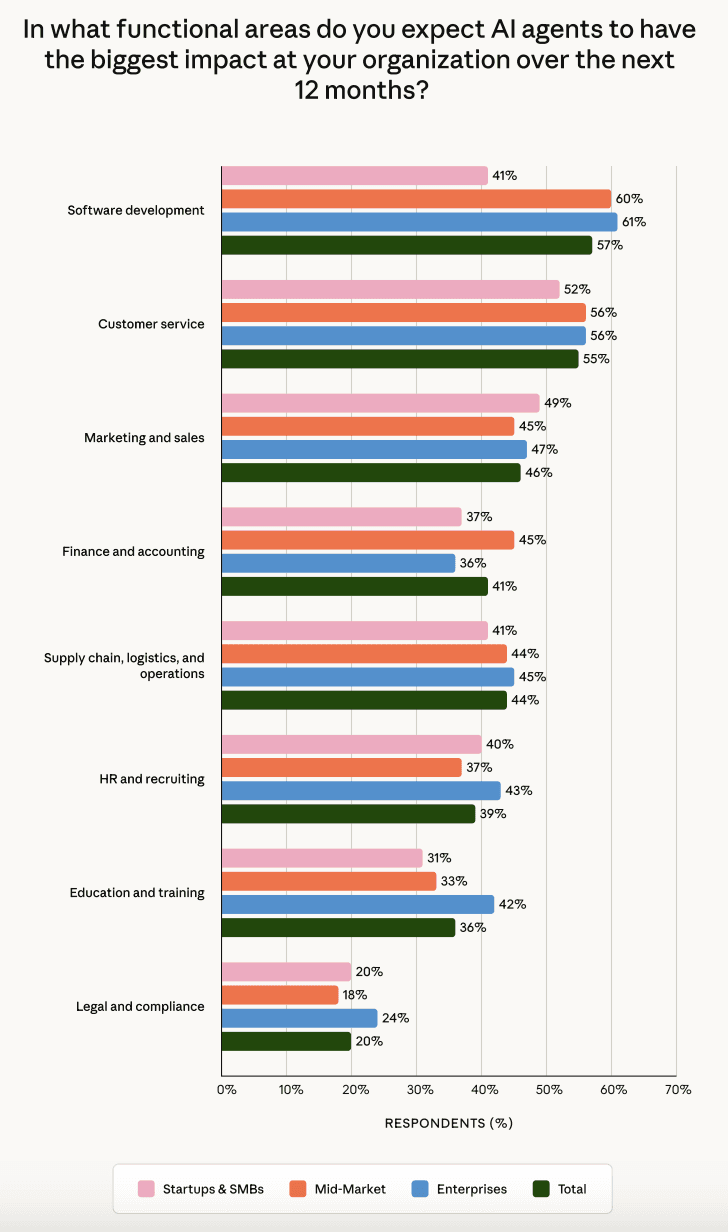
The 2026 State of AI Agents Report
The takeaway is simple - AI is no longer treated as a side experiment. It’s becoming operational infrastructure. And once AI becomes infrastructure, visibility inside AI systems stops being optional. It becomes foundational.
If your brand is not part of the knowledge layer these systems rely on, it doesn’t matter how polished your website looks. You might exist online, but you won’t exist in the answers people actually consume.
If AI can’t explain your business, you have a problem
There’s a simple test most brands never run.
Open ChatGPT or Perplexity and ask:
“What does [your company name] do?”
If the answer is vague, outdated or slightly off, that’s rarely an AI failure. It’s a visibility failure. LLMs don’t invent authority. They assemble it from trusted sources, repeated mentions, consistent narratives and expert-driven content. If those signals don’t exist, the model has nothing solid to work with. And if AI can’t summarize your business clearly, customers will struggle to do the same.
SEO isn’t dying. Mediocrity is.
SEO is not dead. But mechanical, formula-based SEO is losing relevance fast. Keyword-stuffed articles, generic “Top 5” lists and mass-produced content might still rank, but they rarely become reference points. LLMs are designed to reward understanding, not volume. They compress information and filter out repetition, vague claims and empty phrasing.
Think of SEO as learning the rules of chess. LLM visibility is about understanding the game itself. You’re still playing on the same board, but the board keeps moving.
Being loud is not the same as being heard
One of the biggest misconceptions in modern marketing is that visibility equals volume. More posts, more formats and more channels are often treated as the solution.
LLMs don’t amplify noise. They remove it.
These systems are trained to compress information, not hype it. That’s why brands chasing virality often lose authority over time. Virality is gambling. Authority compounds. And LLMs are surprisingly good at spotting the difference.
What working content actually has in common
Content that performs well in LLM-driven environments tends to share a few common traits. It has a clear point of view, offers original framing and is written by people who understand the subject rather than simply following SEO formulas.
Length is not the differentiator. Depth is.
Shrek wasn’t interesting because he was loud. He was interesting because he had layers. One-layer marketing gets summarized. Multi-layer thinking gets cited.
Why early-stage brands should care even more
For startups and early-stage brands, LLM visibility matters disproportionately. They don’t have decades of backlinks or strong brand recognition, but they do have something powerful: the ability to shape their narrative early.
LLMs reward clarity, consistency and expertise more than sheer scale. Brands that invest early in being understandable, not just discoverable, build an advantage that quietly compounds over time. It’s not flashy, but it’s durable.
What that shift really means
LLM visibility isn’t about gaming algorithms or chasing the next shortcut. It’s about earning relevance in systems designed to explain the world. As AI increasingly becomes the interface through which people access information, visibility stops being a distribution problem and starts becoming a meaning problem.
Brands that win in this environment don’t produce more content. They produce clearer thinking. They show up consistently in the right contexts, with the right narrative, at the right moment. They are understandable before they are discoverable.
This is exactly the gap most teams struggle with today. Knowing what to say is one thing. Turning that into content that actually builds authority - and gets picked up, summarized and referenced by LLMs - is another.
That’s where tools like JackSEO come in. Not to replace thinking, but to support it. To help turn ideas, expertise and timely insights into content that’s structured, on-brand and visible - not just in search results, but inside the systems that increasingly shape how people learn, decide and choose.
Because in a world where machines answer the questions, the brands that get quoted are the ones shaping the answers. And visibility, more than ever, belongs to those who know how to make themselves understood.